Semantic search
Search that understands what users mean, not just what they type, delivering results that match intent, mood, and context rather than literal keywords.
Keyword search was built for machines. Users think differently
Traditional search engines look for exact matches. If the word isn’t in the metadata, the result doesn’t appear. A user searching for “something inspiring to watch tonight” gets nothing back. They remember a feeling, not a title.
Semantic search closes that gap. It extracts abstract meaning from free text and represents it as vectors, enabling results based on conceptual similarity rather than literal overlap. No cold start required. It responds to what the user is asking right now, even if it has no history to work from.
Why hybrid is better than pure semantic
Semantic and term-based search are complementary, not competing. Sparse and dense text representations capture different linguistic qualities, combining them consistently outperforms either approach alone, both in-domain and across languages.
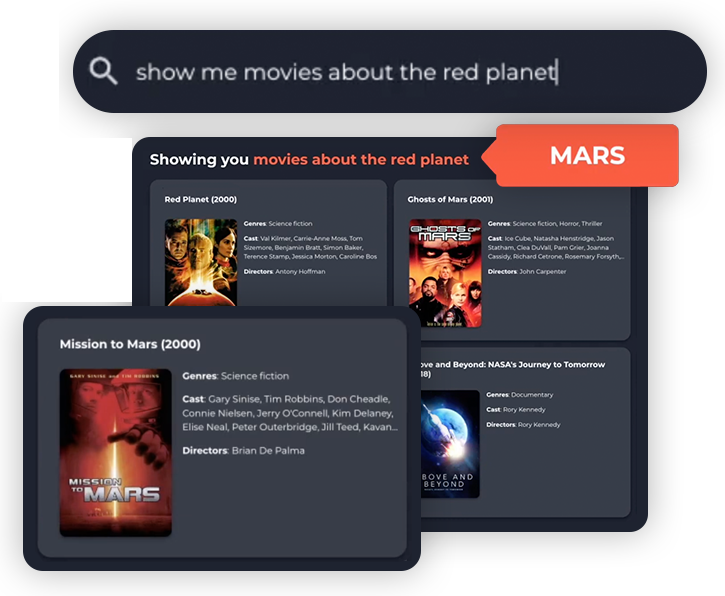
The right balance depends on what the user is doing. A voice query asking for “movies about the red planet” calls for a fully semantic approach. A direct click on an actor’s name calls for exact term matching. Our system adapts the weight dynamically based on query type.
Voice input and open search
Natural language and thematic queries are handled with a predominantly semantic approach, prioritizing synopsis and conceptual meaning.
Metadata and genre browsing
Descriptive metadata triggers a balanced hybrid — returning exact matches alongside semantically related concepts.
Strict metadata (actors, directors)
Direct searches on specific names are handled by term-based matching only, for precision and predictability.
Multilingual by design
Embedding models generalize across languages, enabling consistent search quality regardless of the user’s language.
A modular, production-ready architecture
The system is built around an embedding generation layer that converts both catalog content and user queries into dense vectors, stored and retrieved via approximate nearest-neighbor search. A business rules engine sits on top, allowing editorial and behavioral controls to be applied without touching the underlying model.
The adaptation layer handles domain-specific fine-tuning, so the model learns your catalog’s vocabulary, not just general language patterns.
Download the free PDF and explore how semantic search works in practice

© 2026 Moviri. All rights reserved.